Genesis 29:35—“And she conceived again, and bare a son: and she said, Now will I praise the LORD: therefore she called his name Judah; and left bearing.”
Leah’s life was marked by sorrow and disappointment. Though she was Jacob’s first wife, she was not his favourite. Jacob loved Rachel more, and Leah longed for the affection and acceptance she could not receive from her husband. As each of her first three sons was born, her words revealed her hope that Jacob’s heart would finally turn towards her (Gen. 29:32–34). Yet her longing remained unfulfilled.
When her fourth son was born, however, a remarkable change took place. Leah declared, “Now will I praise the LORD”. Instead of focusing on what she lacked, she fixed her eyes on the abundant grace God had shown her. She recognised that every child was the LORD’s gift and responded with grateful worship. She named her son Judah, meaning “praise”, making thanksgiving to God the testimony of her faith.
Leah’s praise was not because all her problems had disappeared. Jacob’s favour had not changed, nor had her difficult circumstances. Rather, God’s grace had changed the direction of her heart. True praise is born not from perfect circumstances but from confidence in the goodness and faithfulness of the Lord.
Leah’s son Judah became the forefather of Israel’s royal tribe, from whom David and, ultimately, the Lord Jesus Christ would come (Matthew 1:2–3). God graciously honoured the woman who was overlooked by men by including her in His redemptive plan.
Believers today are often tempted to measure God’s goodness by what they have not received. Leah teaches us to praise the Lord for His undeserved mercies, trusting that His wise purposes are always better than our deepest desires. A heart that truly knows God’s grace will always find reasons to say, “Now will I praise the LORD”.
Genesis 28:15—“And, behold, I am with thee, and will keep thee in all places whither thou goest, and will bring thee again into this land; for I will not leave thee, until I have done that which I have spoken to thee of.”
Having deceived his aged father Isaac and wronged his brother Esau, Jacob was forced to flee from home to escape Esau's murderous anger. He left behind his parents, his familiar surroundings, and the security of the promised land, and set out alone on a long and uncertain journey to Haran. Though he possessed the covenant blessing, he was now a lonely fugitive, sleeping in the open wilderness with nothing but a stone for his pillow.
At this moment of fear, guilt, loneliness, and uncertainty, the LORD graciously appeared to him at Bethel in a dream. Instead of abandoning Jacob because of his sins and failures, God reaffirmed the covenant promises first given to Abraham and IsaacIn verse 15, God strengthened Jacob with four precious assurances: His presence (“I am with thee”), His protection (“will keep thee”), His guidance (“will bring thee again into this land”), and His unfailing faithfulness (“I will not leave thee”).
These promises rested not on Jacob’s merit but on God’s sovereign covenant grace. The LORD bound Himself to accomplish all that He had promised. Though Jacob would experience many trials and disappointments, God faithfully preserved him and fulfilled every word. The God who called Jacob also kept him.
These covenant assurances find their fullest expression in Jesus Christ. Christ also commissioned His church with the comforting words, “Lo, I am with you alway, even unto the end of the world” (Matthew 28:20).
Believers today face uncertainties, temptations, and sorrows, yet the Lord’s promise remains unchanged. He does not abandon His children halfway through their pilgrimage. He faithfully accomplishes His gracious purposes in them and safely brings them to their eternal inheritance.
Genesis 22:14—“And Abraham called the name of that place Jehovahjireh: as it is said to this day, In the mount of the LORD it shall be seen.”
Genesis 22 records one of the greatest tests of Abraham’s faith. God commanded him to offer Isaac, the son of promise, as a burnt offering. Abraham acted obediently to offer Isaac as God demanded. At the very moment Abraham was about to sacrifice Isaac, the Angel of the LORD stopped him, and God provided a ram caught in a thicket to be offered in Isaac’s place. In grateful remembrance of this divine intervention, Abraham named the place “Jehovahjireh,” meaning, “The LORD will see or provide.”
This name declares far more than God’s provision of a ram. It reveals the LORD as the faithful God who always provides whatever is necessary to accomplish His holy purposes. Before ascending the mountain, Abraham assured Isaac, “My son, God will provide himself a lamb for a burnt offering” (Gen. 22:8). Though God immediately provided a ram as Isaac’s substitute, the event pointed beyond itself to God’s perfect provision in Jesus Christ, the true Lamb of God who would take away the sins of His people. Hebrews 11:19 further explains that Abraham believed God was able to raise Isaac from the dead, “from whence also he received him in a figure.” Thus, Isaac’s figurative restoration, together with the substitutionary sacrifice of the ram, foreshadowed Christ’s death and resurrection. Where Abraham’s faith was tested, God’s provision was revealed; God would, in the fullness of time, accomplish His greatest provision through the sacrificial death and victorious resurrection of His beloved Son for the redemption of His people.
Believers today must confidently trust in God who provides. His provision does not always remove every trial, but it never fails to supply what His wisdom knows we need. He provides forgiveness through Christ, strength for daily obedience, and grace to endure every test. Jehovahjireh!
Over the past twenty-four years, the Lord has graciously sustained and blessed the ministry of Gethsemane Chinese Service, establishing it as a faithful witness to His saving grace in the Chinese-speaking community and as a biblical congregation where believers gather to worship Him in spirit and in truth.
Though it faced struggles in the beginning, the Chinese Service has stood upon the unchanging foundation of God’s infallible Word. Through reverent worship, faithful preaching of the Scriptures, fervent prayer, and warm Christian fellowship, the Lord has nurtured believers in the knowledge of Christ and strengthened them to live as faithful witnesses. We praise God for every soul saved, every believer established in the faith, and every opportunity to proclaim the glorious Gospel of Jesus Christ.
We thank God for the joyful service of Pr Daniel Lim in preaching the Word and attending to the care of the brethren in the Chinese Service. We also praise God for all who have been co-labouring by offering themselves to lead in worship and the various ministries. There are also brethren who labour sacrificially to bring the worship service online for the benefit of those who are home-bound due to illness or those who are away on foreign assignments. The webcast ministry has been a help to our Chinese-speaking brethren of one of our mission churches, Calvary Kuching BPC in East Malaysia.
This anniversary also reminds us that every spiritual blessing has come solely by the grace of God. Faithful pastors, preachers, translators, musicians, ushers, and many willing brethren laboured diligently, yet it is the Lord who has given the increase (1 Corinthians 3:6–7). We are deeply grateful to all whom God has raised up to serve this ministry through the years.
As we reflect on God’s abundant mercies, we also look ahead with renewed faith. May the Lord continue to preserve the doctrinal faithfulness of the Chinese Service, raise up another generation of faithful servants, and enlarge its witness among Chinese-speaking people in Singapore and beyond. To God alone be all the glory for His unfailing goodness throughout these twenty-four years.
Gethsemane B-P Mission Church, Bohol
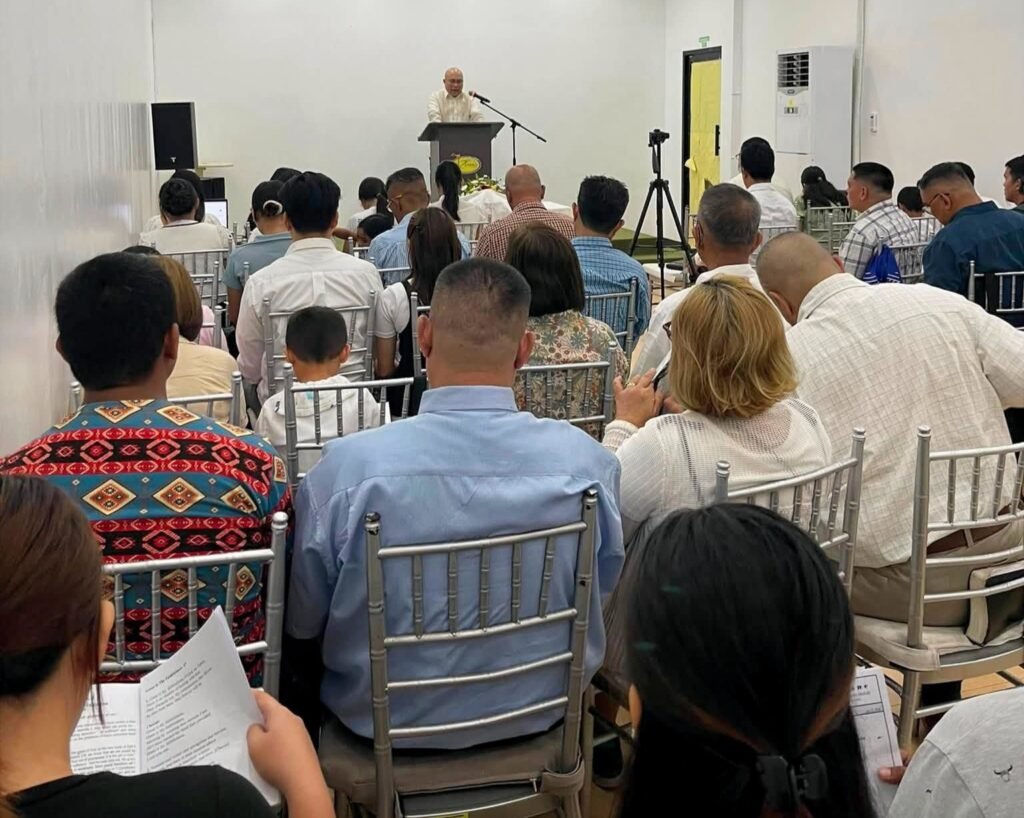
The following report of the 20th Anniversary Service is from Pr Edsel Locot, who serves the Lord in our mission church in Bohol. We thank God for enabling Pr Edsel to serve the Lord faithfully and fervently in his hometown for the last 20 years, upon completing his studies at FEBC. He is ably supported in the ministry by his wife, Sis Juvy, who is a graduate of GBI, Cebu. They have prayerfully been labouring on hard ground. Pastor Reggor Galarpe (GBPC, Cebu) has often travelled to Bohol (almost every month) to provide pastoral supervision for the congregation. Let us thank God for their steadfastness in the work of the Lord for the last 20 years.
Dear Pastor Koshy,
Greetings to you in the Blessed Name of our Lord and Saviour Jesus Christ!
I praise and thank God for the fruitful and blessed 20th Anniversary and Thanksgiving Service held last Sunday. I thank God for His faithfulness in sustaining the mission work in Bohol and for enabling the mission church to reach this significant milestone. All glory and praise belong to our One, living, and true God. As Psalm 115:1 declares: “Not unto us, O LORD, not unto us, but unto thy name give glory, for thy mercy, and for thy truth’s sake.” I praise and thank God for using Gethsemane Bible-Presbyterian Church, Singapore, to uphold and sustain the mission church through its faithful prayers and heartfelt support over the years.
I praise and thank God for enabling Pastor Reggor and 18 brethren from Gethsemane BPC, Cebu, to travel to Bohol to join our anniversary celebration. I thank the Lord for granting them journey mercies and keeping them safe despite the unfavourable weather conditions. I also praise God for strengthening Pastor Reggor to faithfully preach and expound His Word for the edification and encouragement of the members. I thank God that the message of His saving grace was clearly proclaimed to the visitors who joined us.
I pray that the Lord will continue to teach and empower the members of the mission church to trust and serve Him with sincere hearts. May He help us to remain faithful in learning His Word, growing in our faith, and living according to His will each day.
Pastor, I’m sending you photos taken during our anniversary.
1 Thessalonians 2:20—“For ye are our glory and joy.”
Paul concludes this section of his letter with a brief yet deeply affectionate statement: “For ye are our glory and joy.” These words reveal the heart of a true shepherd. The Thessalonian believers were not merely names on a list or members of a congregation; they were the living evidence of God’s grace at work through the ministry entrusted to Paul and his fellow labourers.
The word “glory” expresses honour and delight. Paul did not find his honour in reputation, influence, or earthly achievements, but in seeing believers established in the faith. Likewise, his “joy” sprang not from personal success but from witnessing the spiritual growth of those whom he had served with the gospel. Such joy reflects the heart of Christ, who rejoices over His redeemed people and lovingly cares for His flock.
This verse reminds us that Christian ministry is profoundly relational. God uses His servants not merely to communicate biblical truths but also to nurture His people with love, prayer, encouragement, and faithful example. When believers grow in holiness, remain steadfast in trials, and abound in love, faithful ministers rejoice, giving all glory to God.
Every Christian should likewise seek the spiritual good of others. Parents should rejoice to see their children walk in the truth. Teachers should delight in the spiritual maturity of their students. Church members should encourage one another to grow in grace. Such joy is not rooted in human accomplishment but in the gracious work of God. As we invest our lives in the spiritual welfare of others, we share in the joy of seeing Christ glorified in His people.
1 Thessalonians 2:19—“For what is our hope, or joy, or crown of rejoicing? Are not even ye in the presence of our Lord Jesus Christ at his coming?”
Throughout this chapter, Paul has defended the sincerity of his ministry and expressed his deep affection for the Thessalonian believers. He now lifts their eyes from the present to the future, pointing them to the glorious return of the Lord Jesus Christ. In that day, Paul declares that his “hope, or joy, or crown of rejoicing” will be the believers whom God has brought to faith and nurtured through his ministry.
Paul is not boasting in his own achievements. Rather, he rejoices in the grace of God that has borne spiritual fruit through the faithful preaching of the gospel. The Thessalonian believers are evidence that his labour was not in vain. Their steadfast faith and perseverance will be a source of holy joy when all believers stand before Christ.
This verse reminds us that eternal values must govern Christian service. Earthly success, recognition, and possessions will all pass away, but souls won to Christ and believers strengthened in the faith will remain forever. Every act of faithful gospel ministry has eternal significance because it contributes to the growth of Christ’s kingdom and the glory of His name.
The phrase “at his coming” also reminds us that all ministry will ultimately be evaluated in the presence of the returning Lord. Our desire should therefore be to labour faithfully, not for human praise, but for Christ’s commendation.
May we invest our lives in that which endures forever, praying that many will stand with us in the presence of our Lord Jesus Christ, bringing joy to His servants and glory to His name on that great and glorious day.
1 Thessalonians 2:13—“For this cause also thank we God without ceasing, because, when ye received the word of God which ye heard of us, ye received it not as the word of men, but as it is in truth, the word of God, which effectually worketh also in you that believe.”
Paul gives thanks to God because the Thessalonian believers responded rightly to the gospel he preached. Though they heard the message through human lips, they recognised its true source. They “received it not as the word of men, but as it is in truth, the word of God.” This was not a compliment to Paul’s preaching but a testimony to God’s grace in opening their hearts to receive His divine revelation.
The gospel is proclaimed by human messengers, yet its authority rests not in the messenger but in God, who inspired His Word. Therefore, the hearer’s responsibility is not to evaluate Scripture according to personal preference or human opinion, but to receive it with reverence, faith, and submission. True faith acknowledges the Bible as God’s infallible and authoritative Word, worthy of wholehearted obedience.
Paul further declares that God’s Word “effectually worketh also in you that believe.” The Scriptures are not lifeless words on a page but the living and powerful Word of God. Through the Holy Spirit, they convict of sin, strengthen faith, sanctify the believer, comfort the troubled heart, and transform lives into the likeness of Christ. The Word accomplishes God’s gracious purposes in those who receive it with believing hearts.
Let us therefore approach the Scriptures with humility and expectancy, praying that God would enable us not only to hear His Word but also to believe, obey, and treasure it. As we submit ourselves to its authority, God’s Word will continue to work effectively within us, producing spiritual growth, steadfast faith, and lives that glorify our Lord.
1 Thessalonians 2:7—“But we were gentle among you, even as a nurse cherisheth her children.”
In defending the integrity of his ministry, Paul reminds the Thessalonian believers that his conduct among them was marked not by harshness or self-seeking, but by Christlike gentleness. Having just declared that he sought to please God rather than men (v. 4), Paul now demonstrates that faithful proclamation of the truth should always be marked by gentleness and love. Indeed, true gospel ministry reflects both conviction and compassion.
Paul compares himself and his fellow labourers to “a nurse”, that is, a nursing mother who lovingly nourishes and cares for her own children. Such a mother does not merely provide food; she patiently protects, comforts, and sacrifices herself for her child’s well-being. In the same way, Paul ministered with genuine affection, willingly bearing burdens and seeking the spiritual growth of the believers rather than personal advantage.
This verse reveals the pastoral heart that should characterise all Christian service. Ministers, elders, teachers, and every believer who seeks to help others spiritually must avoid a domineering or impatient spirit. The truth of God must be spoken faithfully, yet always with humility, kindness, and sincere love. As Paul later exhorted Timothy, “the servant of the Lord must not strive; but be gentle unto all men” (2 Timothy 2:24).
Our Lord Jesus Christ perfectly embodied this spirit. Though He spoke with divine authority, He also welcomed the weak, restored the fallen, and dealt tenderly with the weary. As His servants, let us faithfully uphold the truth while cherishing God’s people with the gentleness and self-giving love that adorn the gospel.
1 Thessalonians 2:4—“But as we were allowed of God to be put in trust with the gospel, even so we speak; not as pleasing men, but God, which trieth our hearts.”
Paul reminds the Thessalonian believers that the ministry of the gospel is not a human appointment but a divine trust. The phrase "allowed of God" means that God had tested and approved Paul and his fellow labourers before entrusting them with the sacred responsibility of proclaiming the gospel. Their authority and message came from God, not from human institutions or popular opinion.
To be "put in trust with the gospel" is to become a faithful steward of God’s saving truth. A steward does not alter the message entrusted to him but declares it faithfully. Therefore, Paul states, "even so we speak." He neither softened the truth to gain acceptance nor altered it to avoid persecution. His preaching was governed by fidelity to God rather than the approval of men.
This principle remains essential for every minister, teacher, and believer who bears witness to Christ. In an age when many are tempted to reshape biblical truth to satisfy cultural expectations, the servant of God must remember that the gospel belongs to God. It is not ours to modify but ours to proclaim faithfully.
Paul adds that God "trieth our hearts." The Lord examines not only what we say but also why we say it. He searches our motives, exposing every desire for human applause or personal gain. Faithful service therefore requires both sound doctrine and sincere devotion.
May we cherish the privilege of being entrusted with the gospel, speaking it with courage, humility, and love, always seeking to please the God who knows our hearts rather than the world that judges by outward appearances.